
Don't Build Robots: Why Athletes Freeze Under Pressure
We’ve all seen the player who looks world-class in a warm-up drill but disappears the moment the whistle blows. The gap between technical mastery and game-day performance isn't a lack of talent—it's a lack of chaos. Explore why the best coaching happens at the 80/20 threshold and how to move your training from the "Basement" to the "Arena."
Its been said that the best coaches balance two things:
Repetition of technical skills (to make them automatic)
Chaos and randomness (to build decision-making under pressure)
As Stuart Lancaster said on a recent podcast: “Make sessions random and chaotic, so decision-making becomes unconscious.”
What’s MY coaching philosophy: drill the technique, or coach the chaos?
This is the ultimate “Form vs. Function” debate in sports coaching.
If you lean too far into drills, you produce players who look perfect in warm-ups but freeze when a defender does something unexpected.
If you lean too far into chaos, you get athletes with great instincts but "noisy" mechanics that break down under fatigue.
My philosophy?
My philosophy? I’m a proponent of Representative Learning Design, which is a fancy way of saying: The practice must reflect the game.
Here is how I break down that balance:
The "Basement" vs. The "Arena" I view technical drills as "Basement Work." It’s where you build the foundation (the grip, the footwork, the swing path).
But you can't live in the basement.
The Rule: Technique should be drilled until the athlete understands the mechanic.
The Shift: As soon as the movement is safe and functional, you must move it into the "Arena" (chaos) to see if it survives "perceptual coupling”….. reacting to a real-world trigger rather than a coach’s whistle. (Skills in context)Differential Learning (The Chaos Factor)
I agree with Lancaster. Instead of doing 50 identical reps, I prefer Variable Practice.
If an athlete is practicing shooting, don't just have them run the same line.
Have them do it with variations; have a defender nudge them; run a line & sidestep then shoot, introduce 3d skills etc…
The Goal: By constantly changing the environment, the brain starts to shift from memorising a movement and starts solving a problem.The "Edge of Chaos" Threshold
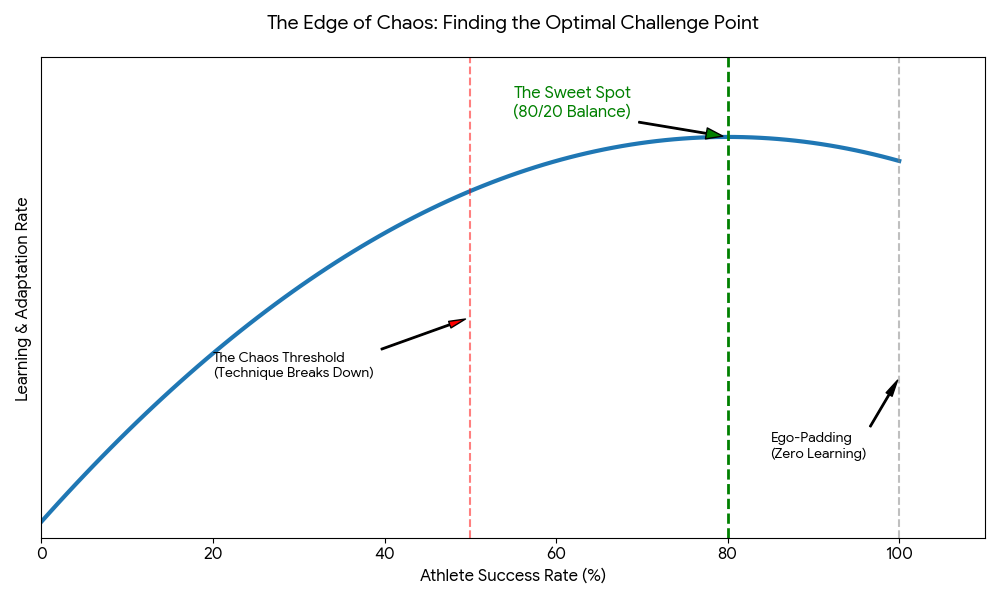
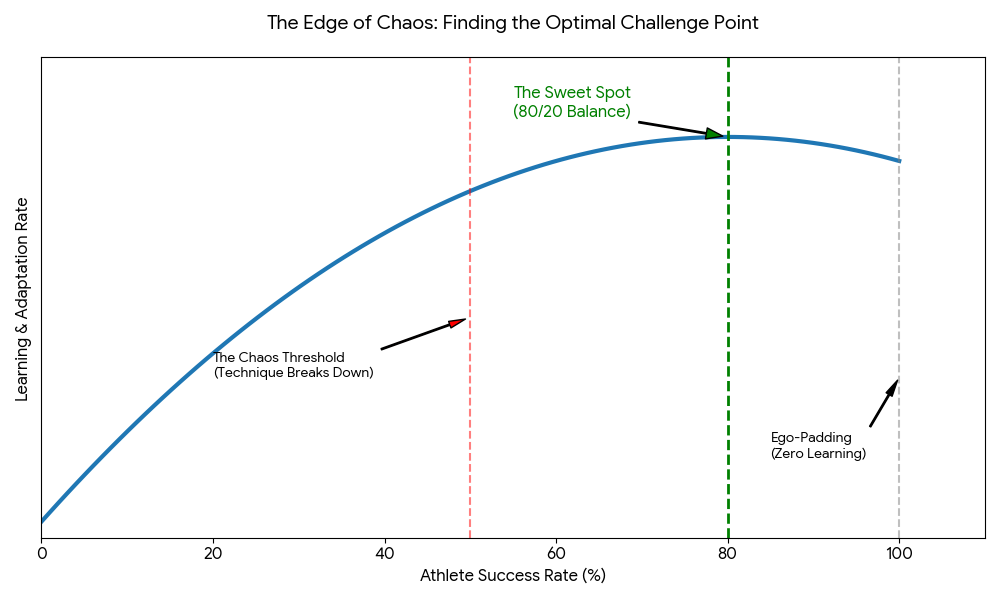
For me, the best coaching happens at around the 80/20 mark.
If an athlete is succeeding 100% of the time in a session, the "chaos" dial is too low. They aren't learning; they’re just ego-padding.
If they are failing 50% of the time, the "chaos" is too high and they are losing the technical thread.
Solving a problem at the Edge of Chaos is more of a neurological process, not necessarily a conscious "inner monologue" for the athlete.
The Sweet Spot: You want them failing just enough that the brain is forced to find a new, more efficient solution whilst still feeling confident in their ability.
The Verdict:
Drill the technique to build the tool, but coach the chaos to teach the athlete how to use it. A sharp sword is useless if the warrior doesn't know how to move in a crowd.
However, every sport has its own threshold.
If you’re a coach, where do you set your 'Chaos Dial'?
Do you believe some technical foundations must be mastered in the 'Basement' before the 'Arena' doors open, or should we be coaching through chaos from day one?
I’d love to hear your experience in the comments.